These days, full-stack technologies like MERN and MEAN are acquiring rapid popularity. Both stacks are built on JavaScript frameworks and libraries, but both have variations in certain important aspects which can affect how a developer looks at a project. The differentiation between the MERN and MEAN stacks is even more pertinent regarding scalability, efficiency, and dynamic applications that businesses have been seeking in 2025.
In this article, we will discuss their differences-Scope of choosing one of them-and break down the stack’s components and their use cases. Whether you’re a business owner who wants to hire a developer or a newbie coder contemplating what tech path to take, this guide is just what you need to navigate the MERN vs. MEAN decision.
Overview of the MERN and MEAN Stacks
Both MERN and MEAN are tech stacks based on JavaScript that are used for building full-stack web applications. They include three core technologies — MongoDB, Express.js, and Node.js — and differ with respect to the front-end library or framework, which is React in the case of MERN and Angular in the case of MEAN.
The world of technology still divides itself into these two options in 2025. MERN basically depends on the advantages of React’s component-based approach to building applications, while MEAN banks on Angular’s opinionated framework for full-fledged application development. Each has its own specifics in the event of building simple or complex web applications.
The commonest thing is that you have a single programming language – JavaScript – across the whole stack. It makes the development much easier, with simpler knowledge transfer from the frontend to the backend. The architecture or performance difference, however, can really change the outcome of your project.
MERN Stack Components
M-E-R-N is the abbreviation for the names of four technologies: MongoDB, Express.js, React, and Node.js. React is a key partner here as it assembles interactive user interfaces and dynamic UIs. This promotes re-usability, makes giving state-handling fairly simple by using tools like Redux or React Query, and provides a seamless developer experience.
In 2025, React still rules the roost when talking about the front end. Having quite an extensive ecosystem with built-in components, hooks, and third-party libraries, it allows for quick development, and custom tweaks to carry out things. MongoDB comes handy as a NoSQL database, and so does React as there is unstructured data needed. The Express and Node backend are really great together.
Thus, we get MERN-an excellent high-performance suite for all your single-page applications (often): real-time tools and applications, where flexibility and customization are important.
MEAN Stack Components
The acronym FSR would mean for MongoDB, Express.js, Angular, and Node.js. Unlike React, Angular is a full framework. So it has out of the box provides routing, form validation, and dependency injection. Thus MEAN is a great option for huge enterprise applications where standardization is crucial.
Angular 2025 is really going great-guns with Google and would be progressively improved to meet modern requirements. It comes with TypeScript by default that enables scalability, type safety, and predictability of the code. It is more difficult to master than React, but once learned most of the development work becomes easier with Angular.
With the result that a team in which equality and tools built-in are better than customized solutions gets out-of-the-box complete development experience.
Front-End React vs. Angular
The most significant distinction between MERN and MEAN is found in the front-end technologies. React and Angular follow completely different philosophies. React is a library aimed solely at the view layer. Angular is rather a framework that is rich with tools.
In 2025, React still has a bigger base of developers and followers. It is lightweight and flexible, allowing developers to integrate whatever tools they need. This kind of modularity is very attractive to startups and fast-moving teams.
Angular stands out for its structure and standards when running in maintainability and scalability-based environments. Angular’s rigid guidelines are a huge boon when working in a regulated industry or with a large team. Too much freedom can be either liberating or paralyzing, depending on the developer’s experience.
React’s Strengths in 2025
With little burden, the React framework’s strength resides in creating highly interactive user interfaces. It has also been derived from a plethora of contributors, which means the tools or libraries and resources constantly keep evolving.
Developers love React because of its components that are reusable, and that makes it easy to manage more complex user interfaces. The arrival of tools such as Next.js and Remix in 2025 has pushed React beyond the SPA boundaries, enabling better SEO, server-side rendering, and static generation.
MERN is perfect for applications with many constant updates, like dashboards, collaboration tools, or social platforms. You can easily deploy your React apps through services like Vercel, further making scaling a breeze.
Angular’s Role in Enterprise Web Apps
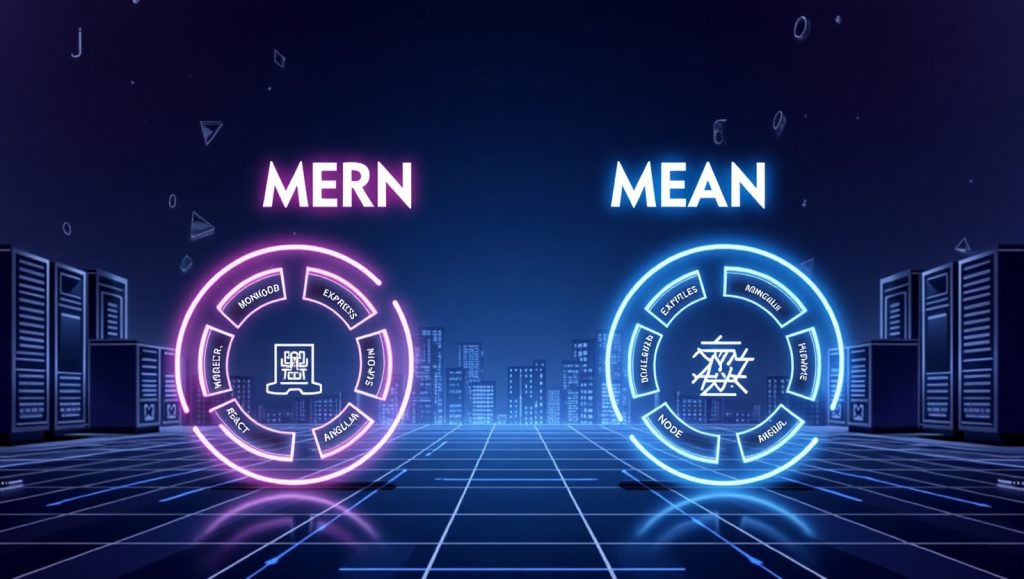
Angular is still the best for enterprise application development. It emphasizes structure and strict type-checking through TypeScript, provides many built-in features, and is a solid framework for large-scale projects. Angular CLI is a beast by now. It makes project development, testing and deployment simple. Features like Angular Universal that improve server-side rendering performance and SEO are well appreciated and sought after by modern web experiences.
Such organizations look for the predictability which Angular brings to its well-defined, consistent development workflows. Banking applications or government websites typically go for MEAN where this is concerned. Firebase works really well with Angular applications because it is integrated into Google’s ecosystem.
Performance and Scalability in 2025
Performance and scalability are critical factors when choosing a tech stack. While both MERN and MEAN boast equally strong back-end support with Node.js and Express.js, their differences lie in the front-end choice affecting the end-user experience.
MERN applications tend to be faster to load and more dynamic thanks to React’s virtual DOM, which enhances rendering speed while putting less strain on the browser. This could serve as a winning factor for apps requiring frequent UI updates.
MEAN apps, on the other hand, are a bit more structured and probably would have higher initial load times because of Angular’s size. Nonetheless, that performance stabilizes in bigger, more complex systems, where Angular’s structure aids in maintaining that consistency while removing bugs.
Both stacks are highly scalable, just differently so. While MERN allows for more expansion flexibility with the module, MEAN sticks to reliability via its structured codes and dependency management.
Hosting, Deployment, and Ecosystem Support
By the year 2025, the deployment options will include serverless and cloud-native. For the MERN stack, Vercel and Netlify will serve to integrate the front end while Heroku or AWS Lambda could be used for the back end in case of serverless applications.
On the other hand, MEAN would more commonly find itself within corporate contexts, where it is integrated into larger CI/CD pipelines using the likes of Jenkins, Docker and Kubernetes. Angular would also particularly be favorable for enterprise cloud services like Azure or GCP.
Both stacks allow and encourage the development of microservices and containerization. It mostly boils down to what the team prefers or what the project necessarily demands, which tremendously depends on maintenance and future costs.
Choosing the Right Stack for Your Project
Which is better is not the question for choosing between MERN and MEAN; rather, the question is which one fits the particular project better. In 2025, that choice is strongly determined by project objectives, team expertise, and long-term vision.
For highly interactive, real-time action, or single-page applications developed by small teams on tight release cycles, MERN is generally favored. This is also added into the equation, since MERN’s learning curve can be fairly gentle for any newcomer.
If, however, it’s an enterprise-grade solution or government portal or corporate tools with very stringent coding policies, MEAN earns points for its built-in structure and features.
Conclusion
By the time one reaches 2025, both MERN and MEAN have not only matured considerably but are also two different paradigms within the web development framework. MERN gives flexibility and speed to developers in teams compared to MEAN, which works on structure and scalability.
A decision toward the liberty of MERN or orderliness of MEAN: Either one stack has all it takes to create modern, responsive, and highly performant web applications. The selection would depend on your team’s expertise, the project requirement, and the project’s future direction.