
Introduction
JavaScript has grown significantly from being a basic language to becoming a complete ecosystem for powering full-stack applications. What used to be a means of merely enhancing interactivity in web browsers is now being used for tasks such as front-end development, server-side programming, database interfacing, and even deployment. The tectonic shift was caused mainly by the advent of frameworks such as Node.js and Express.js, coupled with front-end libraries like React, Angular, and Vue.js. Developers can now build, test, and deploy applications using only JavaScript, depending on which that platform the client wants: Linux, UNIX, Windows, and so forth. Thus full-stack developers need not have an arsenal of programming languages to achieve their goals.
The point of view for using only JavaScript in full-stack development is especially beneficial for the beginner, novice, or startup who wants to keep their learning curves down and spending direct time on the development. The benefits include shorter development cycles, code and logic reusability across stacks, and one type of developer able to address front-end and back-end issues. But there seems to be an open question on just how far you could push-only JavaScript. This article helps explore the grounds of JavaScript’s domain within the layers of full-stack application development while analyzing its strengths and weaknesses to assist in the decision of just going JavaScript for development purposes.
Front-End Development with JavaScript
Building Dynamic User Interfaces
Today, as then, JavaScript is definitely an asset to create a user’s interface, where once it found its sustainability. With libraries like React, and frameworks like Vue.js and Angular, a developer can create highly interactive, component-based front-ends that respond dynamically to user input. The developer can finally create single-page applications (SPAs) where there is no need to refresh the page for the new content to display and pretty much make the user experience seamless. The use of virtual DOM, state management libraries like Redux or Pinia, and reuse of components make development easier and more manageable.
Front-end development shall further be a boon as JavaScript completely operates in unison with HTML and CSS. Developers do DOM manipulations, even event handling and asynchronous fetch calls, all without stepping out of the whereusing, modern JavaScript wherein you have ES6+ async/await, destructuring, template literals, which improve readability and developer efficiency. Through tools such as Babel and Webpack, modern JavaScript writing still yields applications accessible to older browsers.
Responsive Design and Interactivity
Not only does rendering provide UI components, but also JavaScript adds to these applications to make them responsive and accessible. The developer may therefore encapsulate styles in JavaScript through CSS-in-JSs such as styled-components or Emotion, manipulating styles as per application’s state. JavaScript can detect the size of the screen, the nature of user gestures, and the timing of animations, lending to a responsive and interactive web experience. In that way, developers can provision for mobile applications without worrying about separate codebases or frameworks.
Event-listeners and client-side logic to respond to interactivity are JavaScript’s forté. Client-side application features such as form validation, real-time search filters, and dynamic dropdowns draw user attention without the need to go back to the server. With that, developers can craft very intuitive interfaces that respond quickly to the user’s action. Together with APIs like Geolocation, WebSockets, and MediaDevices, JavaScript now gives developers a toolkit for creating rich, immersive experiences on the client side.
Back-End Development with Node.js
Server-Side Logic and APIs
Although mainly intended for client-side applications, Javascript is now complete with Node.js, thereby allowing server-side text logic to be written in the same language as that of the client. By utilizing Node.js, along with the Express.js framework, you can do all of that quickly through javascript with RESTful APIs handling requests, routing, and middleware management. This makes development all the easier, leading to possibilities of reusing codes and maintaining consistencies across the whole application stack. Server-side tasks being performed using JavaScript eliminate the effort of context-switching between languages and provide developers with more productive hours.
With its non-blocking event-driven architecture, JavaScript in Node.js makes handling concurrent requests greatly efficient. This is especially suitable for a scalable web application, a real-time service, or a microservices architecture. Next.js goes further by allowing APIs routes that bring a server-side rendering support for JavaScript-based full-stack applications into the mix, blurring the front-end to back-end line. JavaScript can now let developers build core applications’ logic-including business rules, authentication mechanisms, and routing-without ever stepping outside the language.
Real-Time Applications and WebSockets
With real-time web applications, the possibilities for JavaScript on the server are taken a step further. There is WebSocket support with libraries such as Socket.io, which continues client-server interaction beyond the standard set of protocols using live chat, alerts, and collaborative tools for shared documents and live dashboards. Such features are an absolute need for web applications today, and JavaScript makes it possible to keep those working brilliantly on both ends of the user and the server-it is a pretty friendly environment for development.
In addition, real-time streaming fit very well with asynchronous processing because event-driven programming best suits JavaScript. Multiplayer games, online collaboration tools, and financial dashboards often need suck streaming of data, with minimal latency. Allowing developers using JavaScript on the client with Node.js and WebSockets to tackle real-time projects without including other languages or technologies further enhances its end-to-end capabilities, rendering it more of a full-fledged powerhouse, truly deserving the moniker of JavaScript for full-stack developments.
Database Interaction Using JavaScript
Working with NoSQL and MongoDB
For so many years now, JavaScript has been working very well with NoSQL, especially with MongoDB, a database that stores its data in JSON-like format called BSON. The combination of JavaScript and the BSON structure allows for better data organization and less complexity in data manipulation. With this, a developer can use entirely the same JavaScript syntax and rely on their previous experience to create schemas, validate input data, and perform CRUD operations through An ODM (Object Data Modeling) library for MongoDB called Mongoose. This improves the cycle time of development and reduces the number of misfits during application logic-to-database structure alignments.
MongoDB’s schema flexibility allows it to work efficiently with agile methodologies-in which many JavaScript projects tend to operate. Scrum developers can iterate quickly and even change their data models without worrying about defined tables. This flexibility is especially useful for startups and MVPs, which encounter inevitable changes in requirements. MongoDB’s natively supported JavaScript for aggregation pipelines also makes querying complicated data more intuitive consistent with the entire stack.
SQL Databases and JavaScript ORMs
Libraries like Sequelize, Prisma, and Knex.js help JavaScript interfaces to interact with conventional relational databases, in this case, a development model like PostgreSQL or MySQL. These libraries express themselves as Object Relational Mappers or query builders, ensuring that developers are writing JavaScript code while interfacing with databases built upon SQL. Prisma, for instance, has become quite popular for being type-safe through its full integration with TypeScript – a superset of JavaScript bringing static typing. Thus, preventing run-time errors followed by increased developer confidence.
Using JavaScript in SQL databases does not sacrifice on performance or scale. Different querying levels, migrations, and database relationships can all effectively be handled using ORMs, thus making it possible to set up complex applications, such as CRMs, e-commerce, and booking systems. JavaScript has, therefore, ensured that full-stack developers would not be cut off from using their language and yet ensure that they could choose the best database solution for their specific use case since it supports both the NoSQL and SQL databases.
DevOps and Deployment with JavaScript Tools
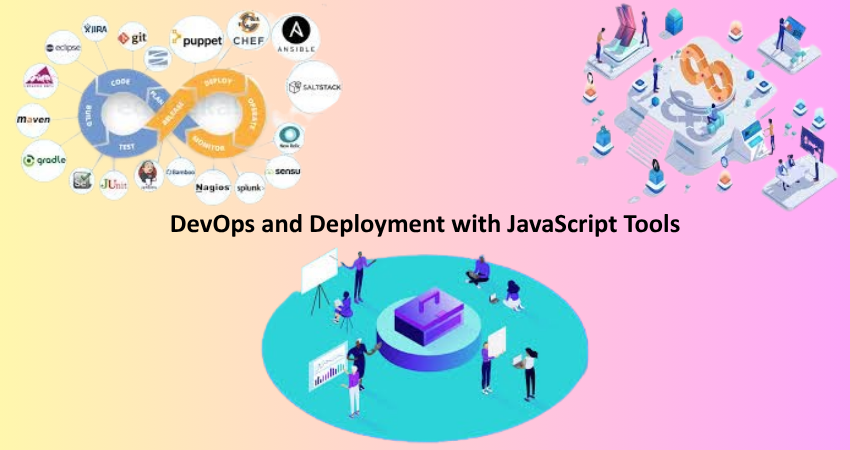
Automated Build and CI/CD Pipelines
Though it was scarcely talked about in the past, JavaScript does extend into some regard into the DevOps arena with Webpack, Gulp, and Grunt tools for the automated build while employing tasks with npm scripts. These provide for an easy way for developers to minify files, transpile code, manage dependencies, and prepare production-ready assets. For CI/CD, JavaScript projects enjoy native support provided by platforms such as GitHub Actions, CircleCI, and Vercel. Therefore, developers configure their pipelines using YAML files and commands based on JavaScript, so their workflow becomes entirely automated from the delivery perspective.
With this automation, manual errors can be eradicated and the release cycles speeded up. Code changes can go into the repository and invoke the automated test suite to deploy the application to either the staging or production environment-these cycles happen within the JavaScript ecosystem. Docker containerization can be dealt with using scripts that run on Node, allowing JavaScript developers to have complete flexibility in managing the build and deployment process. With the proper setup, JavaScript will now serve as a language of both development and delivery.
Hosting and Serverless JavaScript Environments
From early application development on cloud sites such as Vercel, Netlify, and Firebase, deployment of JavaScript applications has got easier. The all-new serverless functions are written in JavaScript, enabling developers to deploy server-side logic without worrying about server maintenance. These serverless functions automatically scale and apply charges based on usage, so they are perfect for projects with inconsistent traffic. Networking JavaScript with these cloud platforms is quite beneficial as it can be used to deploy JAMstack architectures that employ static site generation with dynamic API routes.
Besides, traditional cloud vendors such as AWS, Azure, and Google Cloud can use JavaScript at the same time for serverless computing using AWS Lambda, Azure Functions, and Google Cloud Functions. So, any developer can write, test, and deploy scalable back-end logic using JavaScript directly. These environments abstract infrastructure, and developers focus on business logic only. Thus, not only is JavaScript viable in development, but it also forms part of the hosting and operations processes, closing the full-stack loop from code to cloud.
Conclusion
The transformation of JavaScript from being a browser-based scripting language into an all-inclusive full-stack development powerhouse is nothing less than miraculous. Today, developers can take help from JavaScript to build an interactive front-end, an effective back-end, manage databases, and even deployment and DevOps-from one language! That makes their workflow smoother and increases collaboration between teammates, consequently speeding up the development cycle. Whether you are building an MVP for a startup or scaling an enterprise solution, JavaScript has all the necessary tools and libraries to cover every edge of application development.
It is important, however, to recognize that even though JavaScript takes care of fll due stack development, there are situations in which specialized languages or tools are better than performance, security, or maintainability. Yet just as open and vague as the vast ecosystem of JavaScript continues to evolve, these boundaries are being closed and pushed more and more. Truly, with careful architecture and modern tools, it might be possible to go quite far by only using JavaScript in full-stack development-for many projects, it may be all you ever need.