
Introduction
In the following years, businesses around the globe are to undergo partial digitalization into the decade 2025. Demand for full-stack engineers increases rapidly, as they are capable of performing front- and back-end developments, making them an important factor in reducing time and manpower in every company. With cloud-native applications, AI integration, serverless computing, etc., full-stack roles become more advanced and less defined. The pay is gradually changing into what these developers contribute as their essential roles in every industry’s digital transformation.
Understanding the global salary trends for full-stack engineers is an essential thing for a job seeker and an employer. On the one hand, this will guide the developer in identifying more rewarding job opportunities, and on the other hand, it would help the business with maintaining a competitive offer in a fast-paced hiring environment. This article critically analyzes worldwide compensation trends for 2025, looking closely into regional disparities, salary variations based on experience, and how it has impacted remote work. Furthermore, we’d look at non-monetary benefits, which are gaining much traction in today’s tech economy, as well as a brief outlook on what it holds for the full-stack engineering career moving forward.
The Role of Full-Stack Engineers in 2025
Evolving Responsibilities and Technology Stacks
The disparate roles in full stack engineering have really broadened in response to technological developments as fast as 2025. There exists, therefore, a rising expectation that full-stack engineers now handle everything from the traditional stacks such as LAMP (Linux, Apache, MySQL, PHP) and MERN (MongoDB, Express.js, React, Node.js) and onto work on cloud setups and CI/CD workflows. The FMEC process describes all aspects of working: From prototyping to UX design, on through deployment and post-launch maintenance. These engineers use very versatile skill sets. It has also become normal for full-stack engineers to incorporate DevOps and workflows with container orchestration tools like Docker and Kubernetes, thus making them a link between development and operations.
In addition, the advent of AI-enabled development tools and low-code platforms saw a change in how full-stack developers created software. While a few worried that automation might reduce demand for developers, it has created a higher requirement for engineers who can effectively navigate, integrate, and optimize these tools. Full-stack engineers are now involved in those product strategy talks, architecture designing, and user behavior analysis because this has gone beyond just writing code. In addition, integration into software projects enhances their profiles as high-value professionals in the tech ecosystem.
Core Competencies and Industry Expectations
In 2025, full-stack engineers should improve their skills in technical as well as soft skills to stay relevant. Broadly, they must master all programming tools such as JavaScript, Python, and TypeScript. They are also expected to be familiar with modern frameworks – such as Next.js, SvelteKit, NestJS – when working with databases (SQL and NoSQL) while possessing knowledge about API design, testing, version control (Git), and server-side rendering techniques. Also, knowledge of security principles, regulations concerning data privacy such as GDPR, and performance optimization will be a must.jóða.
Communication, leadership, and teamwork are now considered part of the industry expectations. Full-stack engineers tend to be members of agile development teams that work cohesively with designers, product managers, and QA specialists continually. Employers seek engineers able to convey technical concepts to non-technical stakeholders and participate in formulating project roadmaps with insight. Also, there is an increase in full-stack positions that feature mentoring junior developers in sharing knowledge and conducting peer reviews. The growing demand for such soft skills impinges directly on their pay brackets, where developers capable of switching gears at will are considered sine qua-non to their business success.
Regional Salary Variations in 2025
North America and Western Europe
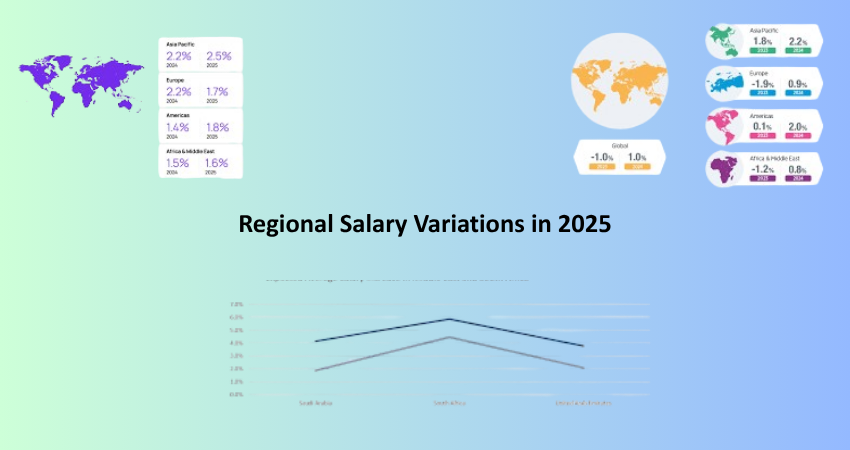
In 2025, full-stack engineers still command some of the highest salaries in North America, particularly the United States and Canada. The range of average base salaries for mid-level full-stack engineers in the U.S. is between $115,000 and $145,000 per annum, whereas senior developers can attract salaries between $150,000 and $190,000. San Francisco, New York City, and Seattle continue to lead on the pay scale, though the trend of working from home has leveled it a bit. Quite a number of companies are imposing location-based salary structures; nevertheless, they are ready to provide above-market salaries to attract the best talents in all walks of life.
In terms of well-paid full-stack developers, Western Europe, particularly Germany, the UK, France, and Netherlands, is able to hold its head high. Base salaries in the mid-level range vary from approximately €65,000 to €95,000 per year, while senior positions in large cities or multinational companies would pay in excess of €100,000. Comparatively, although salaries here appear to be slightly lower than in North America, this is usually balanced by better benefits, stricter labor protection laws, and sometimes lower costs of living. In North America and in Western Europe, bilingual or multilingual engineers with domain expertise (e.g., fintech, medtech) tend to earn a pay premium.
Asia-Pacific, Latin America, and Eastern Europe
Salary levels in the Asia Pacific region remain mixed with many high and low countries to compare in some cases among them. For example, full-stack engineers in countries like Australia and Singapore get paid almost like Western countries, where they earn $90,000-$130,000 from experienced professionals. On the other hand, those in countries such as India, Pakistan, or the Philippines may expect relatively small salary ranges of $15,000-$35,000 a year. However, with the booming global remote job market, pay scales are currently increasing. Many engineers from APAC are becoming employees of foreign firms that offer salaries above the local rates, resulting, ultimately, in pay configurations that are not strictly tied to geography.
It is observed that Eastern Europe and Latin America are becoming well-known destinations for any near-shore development and outsourcing, due to the presence of talented developer communities as cheaper operational costs. Countries like Ukraine, Poland, Brazil, or Argentina tend to be favorable choices for start-ups and medium-sized firms searching for full-stack developers in cheaper rates. The salary range for mid-level developers in these regions is typically $25,000-$55,000 per year, whereas skilled engineers with a profound knowledge of English and international team experience may receive higher remuneration. The growing involvement of developers into global projects has made their salaries rise faster than many of the Western markets.
Salary Benchmarks by Experience Level
Entry-Level and Junior Engineers
By 2025, better options for entry-level and junior full-stack engineers to enter the tech industry through boot camps, apprenticeship programs, and community-led learning environments have started to arise. Salaries for these engineers will vary greatly depending on the job location, type of degree, or prior experience. In the high-paying regions of the U.S., Canada, and some parts of Europe, junior developers could expect somewhere apparently between $60,000 and $80,000 yearly. Companies that offer some sort of very strong onboarding or mentorship program tend to pay slightly less upfront but definitely offer greater career evolution appeal, which really attracts aspiring developers looking for long-term development.
On the other hand, in regions such as Southeast Asia, Eastern Europe, and South America, junior developers are said to typically earn anything from $10,000 to $25,000 a year-typically depending on skills and the size of the hiring organization. The worldwide talent shortage has led many industries to hire junior developers from outside, often at salaries much higher than local averages-sometimes as much as 2 times or 3 times. One positive trend in raising the economic empowerment of remote junior developers who are self-starters is that they may do away with the traditional salary barriers that are enforced by geography on the basis of their work on personal projects, open-source contributions, and continuous skill improvement.
Mid-Level and Senior Engineers
The mid-level full-stack engineers were considered as the very core in 2025 by most of the tech teams in their activities. They typically lead projects while mentoring junior engineers and supervising the technical implementation across stacks. Salaries for such mid-level positions in mature markets average from $90,000 to $130,000 a year depending on the location and industry. Most of these developers will not typically be expected to possess more than 3 to 5 years of actual experience and have broad exposure to a collection of tools and frameworks and capacity to own features or modules from concept to production. Product companies aiming for fast product cycles or having innovation-heavy agendas are willing to pay more to engineers who are strong in reliability and innovation.
Some of the most lucrative professions in technology include senior full-stack engineers. Their salaries start at approximately $140,000 and can increase to over $200,000 in the most demanding markets. Apart from possessing very good technical skills, senior engineers are usually expected to offer architectural direction, conduct code reviews, influence or guide product development, and occasionally interface directly with clients or stakeholders. Their remuneration often constitutes bonuses, investable equity, and other performance incentives. In developing countries, most senior engineers can earn between $40,000 and $80,000 a year—a considerable amount less in absolute terms but often slightly compensated with international remote work options or consulting engagements that considerably supplement income profits.
The Impact of Remote Work on Global Salaries
Remote Work and Geo-Based Pay Models
The global acceptance of remote working conditions has completely altered the salaries for full-stack engineers. By 2025, companies will employ various geo-pay models-from location-adjusted full-salaries to flat global pay. Under the location-based model, engineers from less expensive regions will receive much less pay than their colleagues from more expensive metropolitan cities, even for the same remote job. This has driven some heated discussions among developers, many of whom advocate for equal pay across the board for equal work, irrespective of location. Nevertheless, companies defend the practice on the grounds of cost-of-living differences and internal salary fairness.
Alternatively, some companies, especially those that are aggressively competing for top-level talent, will go flat rate as far as employees’ locations. Normally, these firms advertise salaries closer to those benchmarks from Silicon Valley, making them tempting to engineers across the world. This has yielded great results in talent acquisition but added to payroll spending for the companies. Such models have also coalesced into hybrid such that employees fall under compensation bands along much broader geographic zones, for example, “North America,” “Europe,” or “APAC,” instead of city or country-specific classifications. However, this has struck the right balance for increased openness and negotiation leverage for engineers, and indeed it is one of the most potent forces shaping modern salary trends with regard to remote work arrangements.
Hiring Trends and Global Opportunities
Working from home expanded international employment for full-stack engineers. Developers from traditional outsourcing destinations are now scoring jobs with some of the largest companies in the United States, Canada, and Europe, earning salaries well beyond anything they would find within their borders. Engineering sites such as GitHub, Toptal, and Remote OK have enabled global engineers to create visibility and credibility for themselves. Hiring foreign-developed engineers is no longer limited to start-ups – giants such as Google, Amazon, and Stripe are also hiring software developers worldwide, complete with impeccable on-boarding and scalable support systems.
The consequence of which is profound: the developers, previously having very little to occupy themselves with within their locality, now find themselves paid salaries which catapult them into entirely different quality of life brackets. Such development creates intense competition for employment, where local talent is no longer the restriction that employers are bound by. Companies can hire from anywhere. The global talent hiring spree, however, has introduced worries regarding wage compression in affluent regions, in which developers may see very little local salaries during their salary growth due to the weight of international wage arbitrage. The long-term prospects of this flattening of global talent may indeed see better balance in salary structures while using the economies of some less represented areas for uplifted prosperity.
Future Outlook: Skills, Trends, and Salary Projections

In-Demand Skills That Influence Future Salaries
The high-demand skills concerning future salary determination for full-stack engineers include cloud-native development, AI/ML integration, cybersecurity, and edge computing. These engineers, developing AI-based model integration applications with secure API and distributed network deployment, find higher-than-average salaries awaiting them. Furthermore, specialists in the full-stack domain, such as full-stack data engineering or full-stack mobile development, are also reaping higher rewards since employers want cross-disciplinary expertise.
Soft skills such as leadership, adaptability, and clear communication will also increasingly affect salary levels. Employers are looking not only for working abilities but also how the developer can motivate teams, run cross-functional projects, and support postmortem of strategic initiatives. Engineers blending technical clout with strong commercial understanding can easier influence their pay, especially in positions of leadership and staff level.
Global Salary Forecasts for the Next 5 Years
While the pay scales for full-stack engineers are predicted to increase around the world, from 2025, there would be different rates. The growth will be inevitably slowed in North America and Western Europe due to the market saturation and global competitiveness. However, an increase in salary can still be expected by the developer as a result of his signature specialization and leadership experience. With remote first companies, there will be a pay gap between regions because they will pay for skills rather than location.
While Africa, Southeast Asia, and Latin America would also experience quick salary advancement, that would be equivalent to increasingly higher levels of engagement with the economy. As infrastructure and developer communities improve, these profile areas would become more viable alternatives to the established tech hubs. The widening salary gap between developed and developing markets will be significantly narrowed by 2030 due to shrinkage through skill convergence, global hiring transparency, and demand for varied engineering perspectives.
Conclusion
In 2025, full-stack engineer salaries would not represent an exception. Rather, it would further correlate with the broader international phenomenon, where most technology professionals—in fact, almost without exception—have since started being distributed quite differently across the globe as a function of regional pay differences and remote working dynamics leading to skill-based salaried benchmarks and future trend outlooks. Following these, developer practice in the profession is changing with trends, ongoing education investment, and blessed with a proper understanding of the global hiring landscape. These are the developers most likely to find fruitfully lucrative opportunities. Companies must also learn the emerging pay scales because they want to attract and retain the sort of talent in engineering that is necessary for digital success. In an increasingly inter-related and remote-friendly world, full-stack engineers would once again find themselves at the forefront of evolving innovations—though now their pay is catching up to what they do.
Moreover, as the companies take up the more and more inclusivity and globalization concept in hiring, full-stack engineers are given the opportunity to completely change the outline of a new tech career. Location is losing its edge on barriers, and talent becomes more democratized. Developers belonging to underrepresented regions are finally gaining access to the prestigious roles that were once restricted to the geography. This will go a long way in promising a bright future where skill, commitment, and flexibility—not only geography—determine pay, opportunity, and career advancement.