
Introduction to SEO for Front-End Development
Even though perception makes Search Engine Optimization (SEO) belong to the marketing side, its technical concepts need front-end developers to have a good knowledge on the concept. Structure, code, and render a site affecting its visibility in the search engine results directly. Page speed, mobile responsiveness, semantic HTML, and JavaScript rendering are vital trust factors for SEO that are under the control of front-end developers. Any of the factors mentioned will influence search engines to crawl, index, and rank the content. Hence, when front-end engineers consider SEO guidelines and best practices in their development processes, they will further help to drive organic traffic to the site, improve the user experience, and fine-tune overall performance.
Modern SEO is not just about advertising but is also technical in dealing with issues, such as Core Web Vitals optimization, lazy-loading images, and structured data implementation. It is no longer news that Google’s algorithm updates will use user experience metrics for scoring purposes, thus ensuring that developers would develop speed, access, and mobile-friendliness, making their sites easier to crawl for SEO. The entry of more JavaScript-heavy frameworks such as React and Angular has complicated the process of crawling by search engines. Thus, there is a requirement for server-side rendering or static site generation to make the page well indexed. It is because of this understanding of the technical SEO aspects that front-end developers could put into use concepts of building great-looking web pages that not only attract people but also bring constant organic traffic and business growth.
How Front-End Code Affects SEO Performance
Semantic HTML and Its Role in Search Rankings
Grammar and semantics give a backbone to accessibility and SEO, allowing search engines to know what the content of the web page is. These tags, <header>, <nav>, <main>, <article>, and <footer>, allow all search bots to understand the internal working of structure and informational hierarchy, helpful for indexing and crawling purposes. Examples include placing and styling the layer of headings from <h1> to <h6> in a mere design way; search engines take this as important headings. Similarly, the <img> tag should always accompany adequately phrased alt attributes that allow these images to be readily found through image search. Not forgetting that semantic markup further helps screen readers and supports Google’s position on inclusive design as a ranking factor.
Excessive non-semantic markup with <div> or <span> elements without their corresponding ARIA labels can destroy the meaning of the content and devastate SEO. The mechanism by which search engines find their relevance mostly relies on HTML markings; as demonstrated here, wrapping a product price inside an HTML tag (for example, like <time> or <data>) encased along with microdata enables Google to show rich snippets in the SERP. They should also refrain from using deprecated HTML practices—such as table layouts or inline styles—that bloat pages unnecessarily and limit their ability to be crawled. He said that if developers stick to semantic HTML, they produce cleaner code that is understood more easily by the engines and the users themselves; that in turn, translates into higher ranking in the site and engagement metrics.
JavaScript Rendering and SEO Challenges
The client-side-rendering modern front-end frameworks React, Vue, and Angular pose certain challenges for SEO, especially on their own. Traditionally, search engines have had a hard time executing JavaScript-dependent content and indexing it, which leaves them with partially indexed content or delayed indexing. For instance, if critical content on a web page is rendered via JavaScript after the first loading of the HTML payload, a search bot may perceive only a blank page or a placeholder element without content. This issue, called “content invisibility,” can, therefore, have a severe impact on rankings, especially for sites that are dynamic in nature-e-commerce sites or single-page applications (SPAs) are good examples.
For the first approach, front-end developers need to adopt server-side rendering or static site generation for their applications. In essence, SSR pre-renders a page on the server and sends it back to the browser, making a copy of fully rendered HTML accessible to search engine crawlers. SSR is frequently touted as a feature of frameworks like Next.js and Nuxt.js. Otherwise, SSG (Gatsby, for example) generates static HTML pages at the time of building, resulting in the apparent effect of managing speed with SEO-friendly markup. For hybrids, dynamic rendering can serve static HTML to search bots and deliver more client-side interactivity to users. Finally, developers should also consider the use of Intersection Observer API for lazy-load content without compromising SEO and ensure embedding critical content directly in the initial HTML response.
Performance Optimization and Core Web Vitals
Page Speed as a Ranking Factor
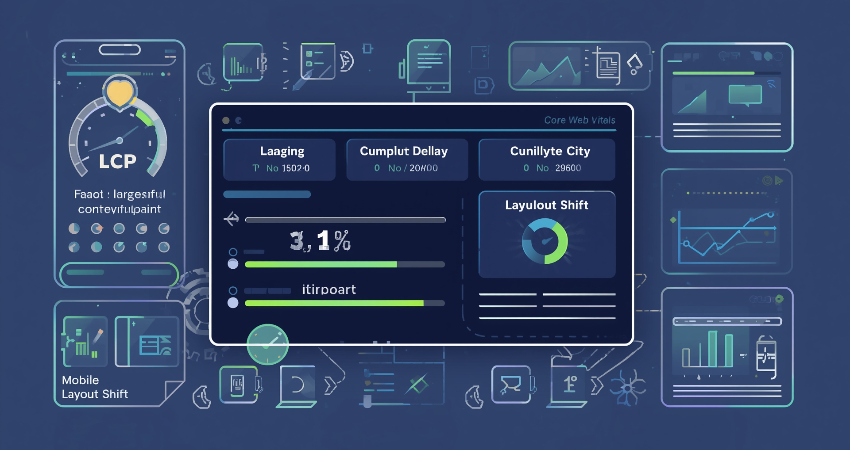
Its Core Web Vitals have made Page speed an absolute measure for ranking and rate performance optimization as one of the top priorities for front-end developers. Parameters like Largest Contentful Paint (LCP), First Input Delay (FID), and Cumulative layout shift (CLS) quantify real-world experience for users. Bad scores can lead to a downgrading of the site in search results. For instance, LCP indicates when most of the main content has loaded. Anything longer than 2.5 seconds is suboptimal. A good portion of bark at all PE is a code split, photo compression, as well as effective caching-in Ends such metric improvement directly earns SEO and user accessibility alike.
Some of the techniques that developers can apply to increase their page speed are minifying render-blocking resources such as non-critical CSS/JS, using modern image formats like WebP/AVIF for the web, and letting the browser cache the content via Cache-Control headers. Performance bottlenecks are audited through tools such as Lighthouse and WebPageTest, while CDNs (Content Delivery Networks) use geographically close servers to reduce latency when delivering assets. Furthermore, optimization of third-party scripts-analytics or ads-would include asynchronous loading or deferred execution so that they do not bottleneck on the main thread. A fast site will rank higher, have a lower bounce rate, and is more likely to convert or receive return visits.
Mobile-First Indexing and Responsive Design
Introduced in mobile-first indexing in the year 2019, Google evaluates rankings based on the website’s mobile version. Hence, front-end developers should ensure that responsive principles are well applied, since unresponsive layouts, fine touch targets, and excessive interstitials all negatively affect search engine optimization. For example, zoom-legal texts and buttons uncomfortably close to one another will annoy a mobile user, thus prompting the user to bounce at a higher rate-cue for negative ranking signals. Fluid grids, flexible images, and CSS media queries maintain runway-wide usability, thus coming to favorability in the sight of search engines.
Another very significant factor is the viewport settings; if the <meta name=”viewport”> tags are not specified or are improperly specified, the mobile rendering of the page will not be carried out properly. While Accelerated Mobile Pages (AMP) have slowly lost steam owing to industry trends, they are still worth the consideration of publishers for whoever needs near-instant loading time. Developers ought to even check for mobile friendliness with Google’s Mobile-Friendly Test and rectify issues like unplayable content or slow mobile speeds. Since mobile accounts for over 60 percent of the total web traffic produced worldwide, there can be no compromise on a seamless mobile experience when it comes to SEO success, and therefore responsive design works to the forefront of responsibilities among the front-end teams.
Structured Data and Rich Snippets
Implementing Schema Markup for Enhanced Listings
If you are familiar with structured data based on the vocabulary as specified in Schema.org, it allows search engines to understand the context of the content and come with rich snippets that have better search results ratings, prices, or FAQs. For instance, just by incorporating the Product schema, an eCommerce site can display star ratings and prices directly in the search result and can thus encourage users to take action and increase the chances of click-through rate. Front-end developers play a very important part in this markup application, whether using JSON-LD (as recommended by Google), Microdata, or RDFa. JSON-LD included in the <head> of a document, is the cleaner approach, as it does not interfere with HTML readability and is easy to maintain.
The common schema types are generally Article, BreadcrumbList, LocalBusiness, and Event, which offer particular forms of enhancement. Subsequently, testing of the markup should be carried out against Google Rich Results Test to ascertain proper implementation. Dynamic structured data also be generated by developers for SPAs through SSR or client-side hydration so that major entities do not miss out on critical information. Rich snippets improve, also serve voice search and AI assistants, thus investment in structured data is forward thinking for SEO purposes.
Avoiding SEO Pitfalls in Dynamic Content
Dynamic content just like user-generated comments or real-time updates can create SEO risks if not correctly used. A typical example is infinite scroll; while user-friendly, it prevents search engines from crawling paginated contents. Developers must therefore implement “View All” pages or rel=”next” / rel=”prev” tags for pagination in order to ensure indexability. As such, any AJAX- or web socket-loaded contents should be backed and echoed in the static HTML for crawlers consumption; or else, you should consider using the History API-to-change URLs for sharing and tracking.
Another pitfall, where parameters in URLs such as ?sort=price are used, is the duplication of content. In such cases, one can only get a diluted ranking authority. The remedies for this at the Front-end include canonical tags that would specify a preferred version of URLs and robots.txt directives that would prevent crawling of such low-value variations of parameters. This way, an SEO penalty is avoided while retaining the kind of dynamic functionality commonly found on most web applications.
Accessibility and Its SEO Benefits

How Accessible Design Improves Search Visibility
A broad A11Y and SEO intersection will be content that is perceivable and navigable by all: humans and crawlers. Descriptive link texts are beneficial for the screen reader and for algorithms analyzing the relevance of the link. (For example: “Read our SEO guide” vs. “Click here.”) A good ARIA label or keyboard-accessible feature enhances crawlability since the bots on the web simulate such user interactions in their usability assessment. Algorithms from Google are increasingly favoring designs that cater to the majority, meaning that accessible sites earn higher ranks in search results because of lower bounce rates and longer dwell times.
Front-end developers should ensure that they are compliant with WCAG guidelines for color contrast, headings, and captions for videos. SEO can be enhanced by correcting accessibility defects with corrective tools such as Axe or WAVE. Accessible sites, in addition to being good for SEO, also serve a variety of purposes for the range of users and comply with different laws such as the ADA and EN 301 549 of EU.
The Role of Progressive Enhancement in SEO
SEO is closely related to progressive enhancement, where you make a simple experience for all users and then enhance it with advanced features. If a website runs without JavaScript, it allows crawlers to index the content even when they cannot execute any scripts. This essentially future-proof the site against algorithm changes and, at the same time, maintain its usability in slower internet and older devices, therefore positively impacting ranking signals. When developing, critical content should be at the top of any initial payload that is delivered and user interactions should be enhanced in an incremental manner with the aid of feature detection.
Additionally, this approach safeguards against any heavily JavaScript-dependent framework by making sure that basic content is available in whatever rendering scenario. When search engines do come across such progressive enhancement sites, they have clean, crawlable HTML as a base; users with modern browsers get interactive enhancements. This duality is particularly useful for SPAs (Single Page Applications) that usually run into SEO issues with traditional client-side rendering. Thus, progressive enhancement mitigates indexing loopholes while retaining freedom of development through the plus of separating content delivery from presentation logic. Eleventy and Astro demonstrate this by producing static HTML output possibly hydrated, which offers the best of SSR and dynamic functionality with the caveat that SEO fundamentals would not be compromised.
Conclusion: SEO as a Core Front-End Skill
SEO is no longer optional for front-end developers-but becoming proficient in bringing forth business outcomes through technical execution has proved very important. Training between mastering semantic HTML and performance optimization, structured data, and accessibility pushes developers towards building sites that score highly and convert users even in algorithm updates. Collaborating with SEO specialists would be useful, but providing this learning to front-end teams helps them realize the greater, more lengthy benefits on their own.
Search engine evolution will not change the fact that user experience and technical excellence form the substrate of good SEO. Front end developers who adapt will only increase their worth in the job market, apart from making direct contributions to revenue behind organic traffic. In an age when visibility means viability, SEO development is the ultimate competitive advantage.