
Introduction
Open the door to a dynamic future in full-stack application development, where cutting-edge techniques and solutions are continuously being worked toward. What was slightly more visible as the stage grew dimmer while the curtains fell is now entirely away. Writing code on both ends is not the work of a full-stack developer in 2025; the job requires understanding cloud-native architecture, DevOps practices, security parts, and modern UI/UX principles. An all-in-one developer will be referred to as a jack-of-all-trades with specialization in current tools, frameworks, and methodologies. In less time and with maximum efficiency, businesses want professionals who can deliver scalable, performant, and user-friendly applications.
The year 2025 has set a very high standard for the full-stack developer thanks to the advent of microservices and headless CMS along with serverless computing and AI integration. In course of time, making strides in the skill sets becomes indispensable if one wants to remain relevant and competitive in perfidious environment. Also, knowing the languages, frameworks, and tools to master could make the difference between thriving or apathy in one’s career. This article therefore highlights some of the most critical full stack development skills that will be important for the years to come in 2025 and gives in-depth insight and explanation to help you navigate the future changing face of technology.
Mastery of Modern Front-End Frameworks
React, Vue, and Svelte in the Evolving Front-End Ecosystem
By the year 2025, giving credence to the gentle predictions, the front-end programmer might be seen as a person capable of high-ended sophistication, as different from just a developer of static web pages or even responsive layouts. Today’s application would stand out by providing reactive interfaces and accessible user experiences with robust state management, attributes mainly given to modern frameworks such as React.js, Vue.js, or Svelte. Meta’s React will still remain the number one simply because of its flexibility, massive ecosystem library, and component-based architecture. Integration with tools such as Redux, React Query, and Next.js gives React such immense relevance in the field of production-grade applications. Vue allows for an easy way of progressive design that is suited for teams who require speed with power. Svelte, on the other hand, is capturing market attention because of its compile-time approach, eliminating most runtime overheads and leading to faster, lighter products in practice.
Naked understanding even how these frameworks work under the hood is an all-important lesson in the life of a full-stack developer. Concepts like virtual DOM, reactive rendering, hooks and component lifecycle mastery enable developers to write code that is efficient and easier to maintain. Each framework has its ecosystem, its CLI tools, and its debugging processes. A 2025 full-stack developer should know how to create components and optimize them for accessibility, responsiveness, and performance. As PWAs and mobile-first experiences are increasingly being thrown at developers, front ends will need to properly interface with APIs while gracefully handling errors and loading as efficiently on any device as possible.
Component-Driven Architecture and Reusability
With the increasing complexity of web applications, modularity and reusability have become two key properties of any modern front-end codebase. If there were ever any doubt about this need, in 2025, we will surely affirm that component-driven development is a necessity. React and Vue advocate decomposing interfaces into small, testable, and reusable components that can then be assembled into larger user interfaces. This architecture allows for consistency, scalability, and maintainability, especially in large teams of developers and enterprise environments. A design system or component libraries such as Storybook, Chakra UI, or Material UI allow teams to maintain congruence in visual appearance and functionality across various products.
The reusability of components is directed not just for alleviation of development time; it also nurtures clean, declarative, and context-sensitive code generation. A developer has to learn to consider logic and styles in an abstract sense, pass props wisely, and promote DRY (Don’t Repeat Yourself) principles. Development environment enhancement comes from type safety with tools such as TypeScript by helping detect bugs before runtime and aiding in scaling. With the rise of awareness for accessibility and localization, reusable components should be built with a mind for semantics and flexibility. In 2025, companies look for developers who can create testable UI components that are consistent in design, scale easily, and have minimal code duplication and maximum user experience.
Proficiency in Back-End Frameworks and APIs
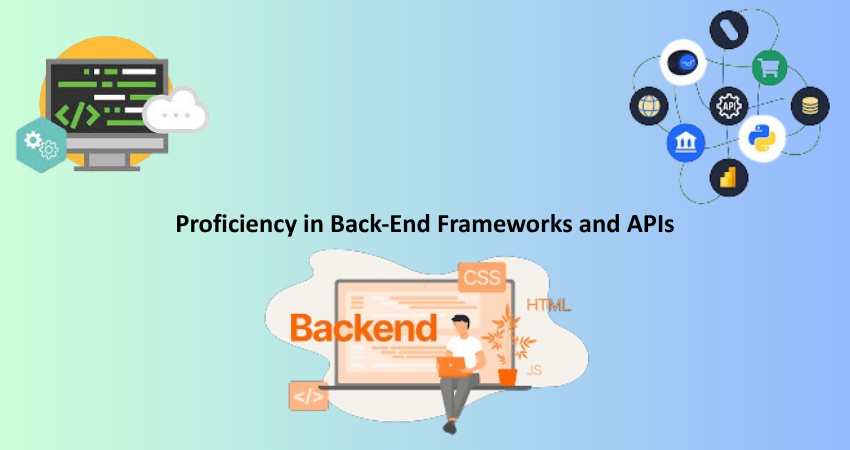
Building with Node.js, Express, and Deno
Back-end technologies have experienced much the same rate of evolution in tandem with those at the front end. Node will be a stronghold for server-side JavaScript to run and manage the entire stack with just one language in 2025. Express is still the favorite framework for building RESTful APIs, known for its minimalism and flexibility in syntax. Others are gaining traction such as Fastify and Koa, boasting greater performance and extensibility. Deno, the alternative created by the original author of Node, is gradually finding glory with many modern features: in-built TypeScript support, better security, and ES module support.
An assurance guarantees the result sought without any qualification. The mastery of Node.js and the Express framework means an internalization of eventing and non-blocking I/O models per which Node.js is well suited for scalable networked applications. Developers would implement Route Handlers, middleware chains, and integration with various databases, such as MongoDB, PostgreSQL, or Redis. Error handling, logging, and performance monitoring constitute particularly critical areas of NPFS emphasis for production-ready backends. Further, while Deno gains acceptance, adaptability will ensure that a developer is kept abreast with what many companies now consider alternatives to the traditional Node environment. Hence, proficiency in fast, secure, and scalable server-side application platforms will address the server-side applications that are able to bear the external demands of modern web applications.
RESTful and GraphQL API Design
Building the proper design for the APIs becomes essential, as they are actually the bridges between the client interfaces and back-end data, which are crucial for a seamless application performance. RESTful APIs have been the go-to standard since offering predictable URL-based endpoints for CRUD operations. However, as 2025 came closer, GraphQL overtook all its competitors, especially in complex applications developing flexible data queries. GraphQL allows clients to specify just what you want without under-fetching or over-fetching like REST does. This very characteristic makes it favorable in terms of bandwidth and performance for mobile and SPA applications.
Worthy of mention, a full-stack developer should possess the skill for designing scalable, secure, and efficient APIs: a requirement that leaves no room for negotiation. Any citizen of this great REST world requires an energetic gospel: APIs must be well-designed, having considered issues of endpoint design, HTTP status codes, and response formats. Out of the mentioned selling points, standard operating procedures on using some kind of authentication middleware, validating your requests, and rate limiting should be observed. For GraphQL, developers will be required to think through the design of their schemas and resolvers and analyze the complexity of their queries so as to avoid performance pitfalls. Developing real-time APIs with active subscriptions and advanced access controls has never been made easier with the likes of Apollo Server or Hasura. API fluency in both REST and GraphQL ecosystems is now being considered one of the most prominent full-stack skills to have in 2025.
Database and Data Management Expertise
Working with SQL and NoSQL Databases
In a couple of years, by the year 2025, full-stack developers will be expected to show fluency-both in relational and non-relational databases, that is, SQL and NoSQL. PostgreSQL and MySQL are SQL databases suitable for applications built using a structured data model, complex queries, as well as requirements for ACID compliance. MongoDB, CouchDB, and DynamoDB, however, are not used for flexible and scalable applications, especially those built real-time, or systems that manage collections of unstructured data. The choice of the database system should be based on the needs of the application, and herein, full-stack developers should be expected to make such architectural decisions.
Mastery of SQL entails knowing table structuring, joins, indexing, transactions and stored procedures. In NoSQL database context, one should learn document-based data models, sharding and eventual consistency. Most modern applications apply the polyglot persistence strategy to use several databases suited for different tasks. Integration of systems into ORMs such as Sequelize or Prisma will also enhance data interaction and code readability of developers. Furthermore, experience with cloud-hosted database services like Firebase or AWS RDS adds to value. In a data-driven world, the full-stack developer must manage, tune and query data regardless of the storage used.
Managing Data with ORM and Query Builders
ORM-Object Relations Mapping tools and query builders have become very much integral with contemporary development workflow when bridging the gap between code and database. This tool lets developers access data through the language’s native objects or methods. By 2025, Prisma, TypeORM, and Knex.js continue to dominate with type-safety, migration support, and clean syntax features. The best part is that there is no boilerplate code, another downside is that it is safe from SQL injections, and maintaining interactions on databases becomes easier, especially when there are several applications involved.
It is increasingly vital for developers to learn strategies to declare models and relations, seed data for testing, and write performance-sensitive queries using ORM abstractions in the true sense. Full-stack developers are charged more with version-controlled schema migrations, transaction handling, and data integrity through validation layers than fetching and storing data. The rise in complexity that comes with application growth makes the advantages of ORM quite apparent, offering simplicity and, equally so, consistency across environments. Learning to leverage these tools will enable developers to write code that is secure, scalable, and maintainable for future business and also technical changes.
DevOps and Deployment Knowledge
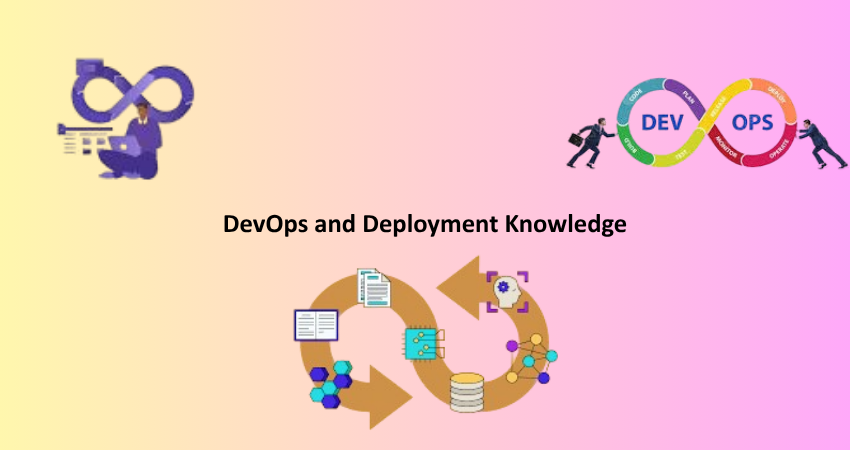
Understanding CI/CD and Deployment Pipelines
In the year 2025, third thing to do as a full-stack developer is not just writing code but being familiar with those systems that get the code to users. The practices of DevOps for speeding software delivery are Continuous Integration and Continuous Deployment (CI/CD). Tools such as GitHub Actions, GitLab CI, and CircleCI automate the build-and-test-and-deploy cycle and speed up feedback while reducing manual error. CI/CD skills have become a core expectation in development roles; these days, they are no longer optional.
Developers need to have a working knowledge of how to write YAML configuration files to automate pipelines; to set up runners for testing, followed by deployments to staging or production environments; and to use Docker for containerization, along with orchestration tools such as Kubernetes or Docker Swarm to deploy their applications. CI/CD helps in automatically validating and securely deploying code that is pushed into repositories and thereby creates reliability and reduces downtime. Thus, mastering these tools allows developers to deliver features on time, detect bugs early, and maintain solid code quality-these are good characteristics for anyone aiming to attain full-stack excellence by 2025.
Working with Cloud Platforms and Containers
The cloud has indeed become, in recent years, the go-to infrastructure for deploying and scaling web applications at all levels. Full-stack developers in 2025 should be familiar with such platforms as AWS or Google Cloud or even Microsoft Azure, as well as have a command of various containerization and orchestration tools, such as Docker and Kubernetes, to be competitive. Full cloud applications are developed with a maximum level of scalability, availability, and cost-efficiency in mind; knowing namely, how each different service offering- i.e., EC2, Lambda, Firebase, or App Engine—actually compliments the whole service will allow a developer to arrive at better-informed deployment choices.
Definitely there is a way to package applications and dependencies into isolated environments so that they can behave the same across systems: Containers. Kubernetes is an orchestration that manages clusters of containers and automates deployment, scaling, and failover. A developer should understand pod management, load balancing, and auto-scaling policies. Tools driven by Infrastructure as Code (IaC) such as Terraform or Pulumi are gaining prominence for replicating environments and maintaining consistency across teams. Having knowledge of cloud and container makes full-stack developers extremely versatile and an asset in commercial settings, where scalability and uptime are admittedly paramount.
Conclusion
With the arrival of the year 2025, it becomes all the more imperative to adopt all that full-stack development stands for. Full-stack development includes a lot more than just page building and API creation. Therefore, a truly modern full-stack developer must understand everything from the front-end frameworks to back-end architectures, constants of data management, and DevOps to cloud infrastructure. Understanding these areas ensures that you can develop fast, scalable, secure, and user-friendly applications that meet the demands of the most complicated digital natives of today’s world.
In this regard, one should constantly be learning and practicing in order to remain relevant. Evolution and adaptation to such will therefore be the hallmark of the best full-stack developers for 2025. Such would involve balancing the fundamentals with the readiness to grab new trends. Therefore, whether you just started or want to hone your already acquired skills, these ideas will lead you to that coveted perfect well-rounded full-stack developer in the coming year and beyond.